
I am an experienced and dedicated professional with a background in Devops. I have obtained the AWS Solution Architect Associate certification, showcasing my proficiency in cloud computing technologies. Currently, I am pursuing my interest in DevOps, aiming to further expand my knowledge and contribute to the seamless integration of development and operations.
What time.com allows people to know what is the current time.
It doesn't require any database.
It is fully vertical and horizontal Scalable, no downtime.
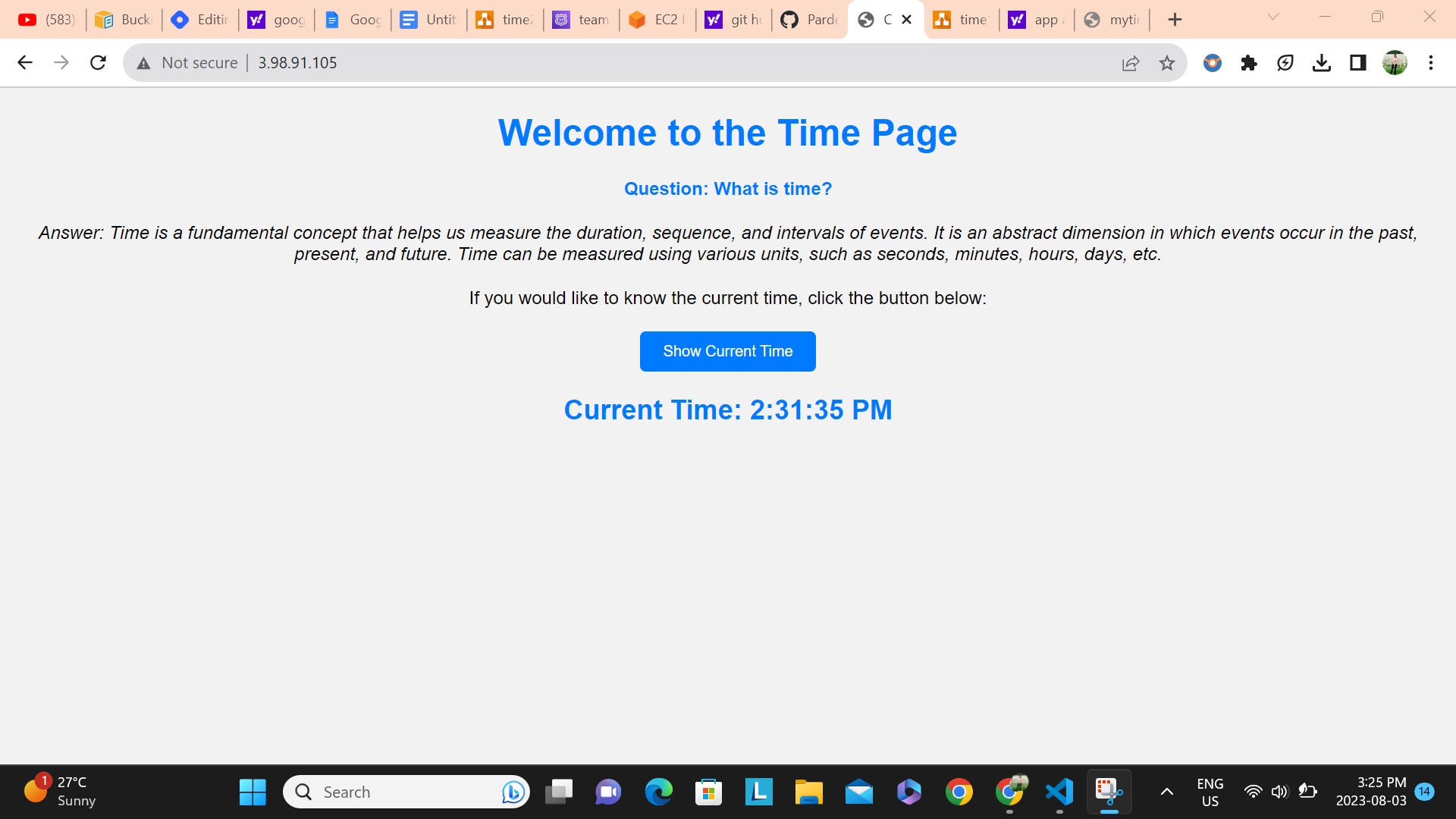
Let me provide a brief overview of the services you mentioned and how they work together:
Route 53: It is Amazon's highly scalable Domain Name System (DNS) web service. You can use it to register and manage domain names, and it also helps to route incoming traffic to the appropriate resources. In your case, you might have set up a domain name (e.g., myapp.example.com) and configured Route 53 to point to the Elastic Load Balancer (ELB) to distribute traffic to your instances.
EC2 m5 Instance: An m5 instance is one of the many types of Elastic Compute Cloud (EC2) instances provided by AWS. It offers a balanced mix of compute, memory, and networking resources. You likely deployed your application on one or more m5 instances to handle user requests.
Auto Scaling Group (ASG): The Auto Scaling Group allows you to maintain the desired number of instances running at all times. It automatically adjusts the number of instances based on conditions you define (e.g., scaling in/out based on CPU utilization, network traffic, etc.). This ensures that your application can handle varying levels of load efficiently.
Multi-AZ: Multi-AZ (Availability Zone) configuration provides high availability for your instances by deploying them across multiple data centers (Availability Zones) within a region. If one Availability Zone experiences an issue, the instances in other AZs can continue to serve traffic.
Elastic Load Balancer (ELB): ELB is a fully managed load balancer service that distributes incoming application traffic across multiple instances to ensure high availability and fault tolerance. It automatically scales in response to incoming traffic.
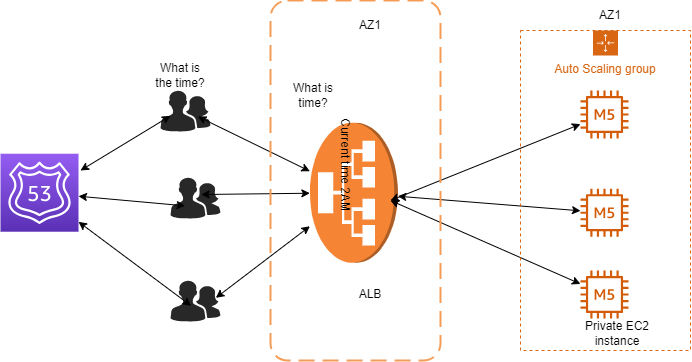
To make the project more scalable, use multi AZ.
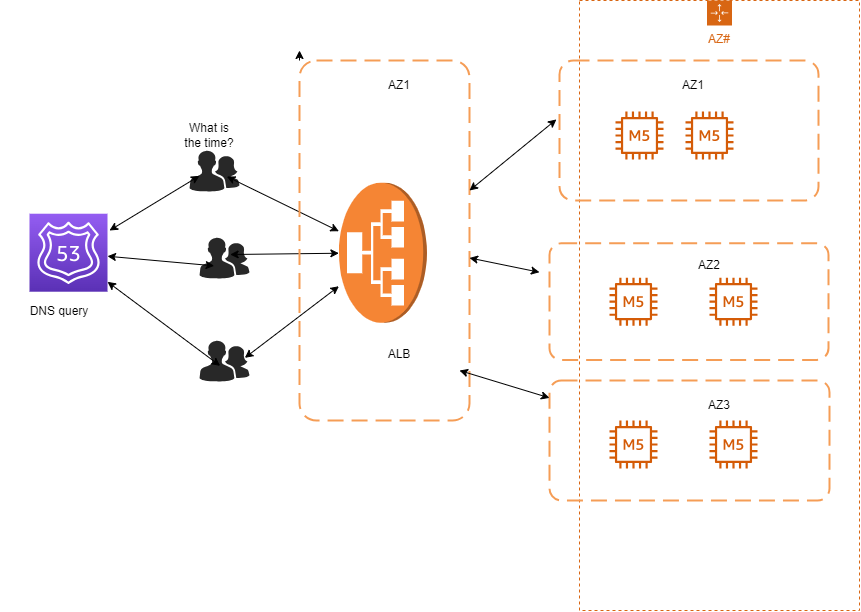
When a user asks your app for the current time, the following sequence might occur:
The user sends a request to your app using the domain name you set up with Route 53 (http://mytimebot.com.teamabc.net/).
Route 53 resolves the domain name to the IP address of the Elastic Load Balancer.
The Elastic Load Balancer distributes the incoming request to one of the instances in the Auto Scaling Group.
The instance processes the request, retrieves the current time, and sends the response back to the user.
If you have set up Multi-AZ, your instances will be distributed across different Availability Zones, ensuring high availability in case of AZ failures.
Overall, your AWS infrastructure should provide a reliable and scalable solution to serve user requests and answer the "What time is it?" queries efficiently.


